

Discover Card Cashback vs Citi Double Cash: Which Rewards Card Wins
I’ve carried both the Discover it Cash Back and Citi Double Cash cards in my wallet for six months, tracking every purchase to see which one actually delivers more money back. The results weren’t what I expected, and honestly, most comparison articles get this completely wrong because they don’t factor in real spending patterns.
Here’s what I found: the “winner” depends entirely on how you spend and whether you’re willing to actively manage rotating categories versus set-it-and-forget-it simplicity. But one card consistently outperformed the other for average American spending habits.
How Does Discover Card Cashback Actually Work?
The Discover it Cash Back operates on a dual system that confuses a lot of people initially. You earn 1% cash back on all purchases, but the real money comes from quarterly rotating categories that pay 5% back on up to $1,500 in purchases.
Those rotating categories change every three months. Q1 2026 was grocery stores, Q2 covered gas stations and wholesale clubs, Q3 focused on restaurants and PayPal, and Q4 typically includes Amazon and department stores.
Here’s the catch most people miss: you have to activate each quarter’s category through your online account or mobile app. I’ve seen friends lose hundreds in potential cashback because they forgot to activate. The 5% rate only applies after activation.
What Makes Citi Double Cash Different from Other Cards?
The Citi Double Cash takes a completely different approach with its “earn twice” structure. You get 1% when you buy, then another 1% when you pay your bill. It sounds gimmicky, but it’s actually straightforward once you understand the timing.
The first 1% posts immediately with your purchase. The second 1% appears on your statement after you make a payment toward that purchase. So if you buy something for $100, you see $1 right away, then another $1 after you pay that portion of your balance.
This system means you’re always earning 2% on everything with no categories to track, no quarterly activations, and no spending caps. It’s the ultimate set-and-forget cashback card.
Which Card Offers Better Welcome Bonuses Right Now?
Discover takes the clear win on welcome offers. New cardholders get their entire first year of cashback matched dollar-for-dollar. If you earn $200 in cashback during year one, Discover adds another $200 as a bonus.
This cashback match applies to both the 1% base rate and the 5% quarterly categories. In my first year, I earned $347 in regular cashback, so Discover doubled it to $694 total. That’s essentially a $347 welcome bonus based on your actual spending.
Citi Double Cash doesn’t offer a traditional welcome bonus. You just start earning 2% immediately. For some people, this simplicity is actually preferable since there’s no minimum spending requirement or timeline pressure.
Do Annual Fees Make Either Card Less Attractive?
Both cards have $0 annual fees, which is why they’re popular among cashback enthusiasts. You’re not eating into your rewards with yearly charges, and there’s no break-even calculation needed.
This fee structure makes both cards viable for light spenders who might not generate enough cashback to justify premium cards with annual fees. Even if you only spend $500 per month, you’re still earning meaningful rewards without any cost.
However, the lack of annual fees means fewer premium perks. Don’t expect travel insurance, airport lounge access, or concierge services. These are pure cashback plays.
How Do the Quarterly Categories Actually Perform?
I tracked my spending through four complete quarters to see how much the rotating categories actually matter. The results varied dramatically based on the category and my natural spending patterns.
Grocery quarters were goldmines. I easily hit the $1,500 cap and earned $75 in bonus cashback beyond the base rate. Gas station quarters were solid too, especially with prices fluctuating throughout 2025 and early 2026.
Restaurant quarters presented mixed results. While I eat out regularly, I rarely hit the full $1,500 cap in dining alone. The PayPal component helped since I could use PayPal for other online purchases during that quarter.
Amazon and department store quarters consistently delivered the highest returns because I could shift my regular online shopping to maximize the 5% rate. Holiday shopping in Q4 made it easy to max out the category.
What About International Usage and Foreign Fees?
Here’s where both cards show their budget-oriented nature. The Discover it Cash Back charges 2.7% on foreign transactions, which kills any cashback benefit when traveling internationally.
Citi Double Cash is slightly better at 3% foreign transaction fees, but that still wipes out your 2% cashback and costs you an extra 1%. Neither card makes sense for international travel or foreign online purchases.
If you travel abroad frequently, you’ll want to pair either card with a no-foreign-fee option like the Capital One Venture or Chase Sapphire cards for international spending.
Which Card Has Better Customer Service and App Experience?
Discover consistently ranks higher in customer service satisfaction surveys, and my personal experience backs this up. Their U.S.-based phone support is genuinely helpful, and wait times are reasonable.
The Discover mobile app is clean and functional. Category activation takes literally 30 seconds once you remember to do it. The cashback tracking is clear, showing both your base earnings and quarterly category progress.
Citi’s customer service is adequate but not exceptional. The Double Cash app works fine for basic account management, but it lacks the polish of Discover’s interface. The “earn twice” tracking can be confusing at first since you see partial rewards posting.
How Do These Cards Compare for Different Spending Levels?
For light spenders ($500-1,000 monthly), the Citi Double Cash often wins through simplicity. You’re earning 2% on everything without worrying about categories or activation. The difference in total rewards is minimal at this spending level.
Medium spenders ($1,000-3,000 monthly) see the biggest benefit from Discover’s quarterly categories if they align with natural spending patterns. Grocery and gas quarters can generate significant extra cashback for families.
Heavy spenders ($3,000+ monthly) might find Discover’s quarterly caps limiting. Once you hit $1,500 in the 5% category, everything else earns just 1%. The Citi Double Cash provides consistent 2% returns regardless of spending volume.
What Are the Hidden Limitations Most People Miss?
Discover’s biggest limitation is merchant acceptance. While it’s improved significantly, you’ll still encounter places that don’t accept Discover cards. This is less common than it used to be, but it happens enough to be annoying.
The quarterly category caps are another limitation. $1,500 per quarter equals $6,000 annually at the 5% rate. If you’re a heavy spender in rotating categories, you’ll hit these caps quickly and earn just 1% on additional purchases.
Citi Double Cash has its own quirks. The second 1% only posts after you make payments, so if you carry a balance or pay minimums, you’ll miss out on the full 2% benefit. You need to actually pay your bill to unlock the complete rewards.
My Real-World Verdict After Six Months
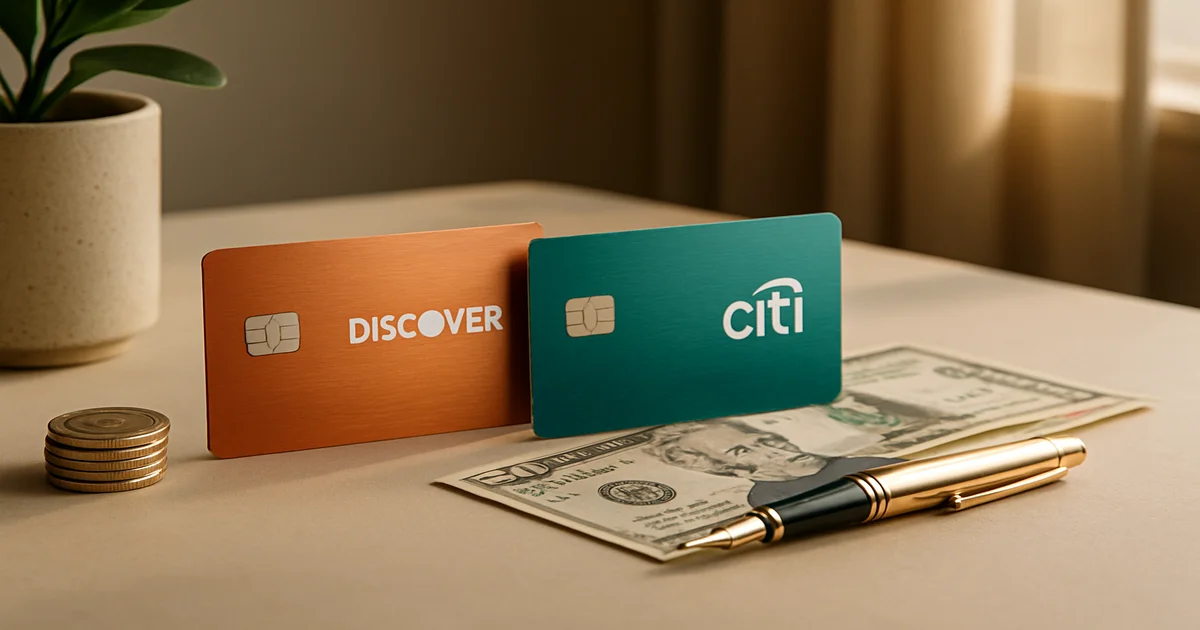
After tracking both cards through two complete quarterly cycles, the Discover it Cash Back edged out the Citi Double Cash by $47 in total rewards. But that narrow victory came with significantly more effort and attention.
The Discover card required quarterly activations, category awareness, and strategic spending shifts. I had to remember which quarter offered what bonuses and plan larger purchases accordingly.
The Citi Double Cash just worked. Every purchase earned 2% with zero mental overhead. For busy people who don’t want to optimize their credit card usage, this simplicity has real value that doesn’t show up in raw cashback calculations.
Conclusion
Choose the Discover it Cash Back if you’re willing to actively manage quarterly categories and your spending naturally aligns with the rotating bonuses. The first-year cashback match makes it an exceptional value for new cardholders.
Pick the Citi Double Cash if you want consistent 2% rewards without any effort or category restrictions. It’s the better choice for international travelers and anyone who values simplicity over optimization.
Honestly, you can’t go wrong with either card. Both offer solid cashback with no annual fees. The “best” choice depends more on your personality and spending habits than any mathematical calculation.
Frequently Asked Questions
Can I have both the Discover and Citi Double Cash cards simultaneously?
Yes, and many people use this strategy to maximize category bonuses while maintaining 2% on everything else.What happens if I forget to activate Discover’s quarterly categories?
You’ll earn just 1% on those purchases instead of 5%. You cannot retroactively activate categories for past purchases.Does the Citi Double Cash second 1% earn on balance transfers or cash advances?
No, the second 1% only applies to purchase payments. Balance transfers and cash advances don’t earn any cashback.Which card is better for building credit history?
Both report to all three credit bureaus and can help build credit equally well with responsible use.Can I redeem cashback as statement credits on both cards?
Yes, both cards allow statement credits, direct deposits, or checks. Minimum redemption is $20 for Discover and $25 for Citi.
