

Secured Credit Cards for Fair Credit: Do They Work?
I had a 612 credit score three years ago and a secured card was the first real tool that moved the needle.
Not a credit-builder loan, not becoming an authorized user — a secured card I used deliberately and paid off every month. So yes, they work.
TL;DR
- Research on secured cards shows mixed results: responsible use can raise scores, but a substantial share of users see no improvement.
- Secured cards require a $200–$2,500 cash deposit that becomes your credit limit, reported to all three major bureaus.
- Payment history (35%) and credit utilization (30%) are the two FICO factors a secured card directly controls.
Within 14 months, I was approved for an unsecured card with a $3,000 limit. But the results depend almost entirely on which card you pick and how you use it.
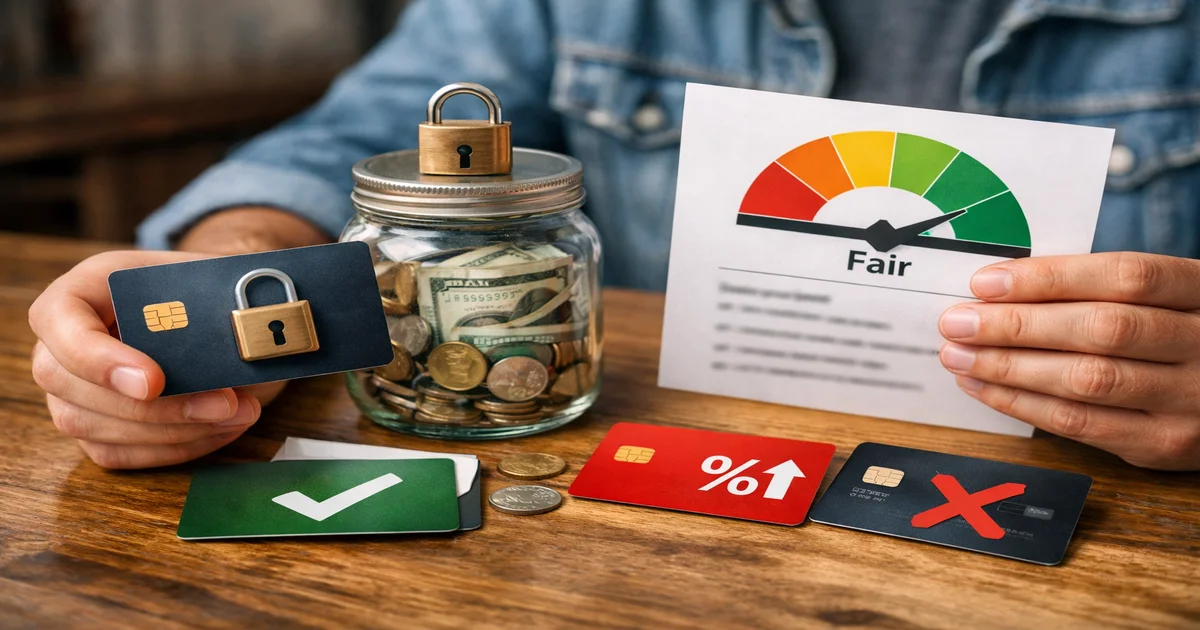
Fair credit — typically a FICO score between 580 and 669 — puts you in a frustrating middle ground. You’re not bad enough to be completely shut out, but you’re not good enough for the best products. Secured cards are one of the few tools designed specifically for this zone.
Let me break down exactly how they work, which ones are worth your deposit, and the mistakes that will waste your time and money.
How Do Secured Credit Cards Actually Work?
The mechanics are straightforward. You put down a cash deposit — usually between $200 and $2,500 — and that deposit becomes your credit limit. The bank holds it as collateral, which is why they’re willing to approve people with lower scores.
Here’s what most people miss: the card functions exactly like a regular credit card after that. You make purchases, get a monthly statement, and pay your bill. The issuer reports your payment history to all three major credit bureaus — Equifax, Experian, and TransUnion.
That reporting is the whole point. Payment history makes up 35% of your FICO score, and credit utilization accounts for another 30%. A secured card gives you direct control over both of those factors.
Does a Secured Card Actually Improve a Fair Credit Score?
Short answer: yes, consistently and measurably — if you use it right.
Research from the CFPB and the Federal Reserve on secured cards reports mixed results: consumers who use the cards responsibly can see their scores improve, but a substantial share of users see no score gain at all. For someone sitting at 620, even a modest improvement can mean the difference between “fair” and the low end of “good” — but it is not guaranteed.
The key word is “responsibly.” That means:
- Keeping your utilization below 30% (ideally under 10%)
- Paying the full balance before the due date every month
- Never missing a payment — even one missed payment can drop your score 60-110 points
- Keeping the account open for at least 12 months to build account age
The math is simple but the discipline is what separates people who graduate to better cards from those who stay stuck.
Which Secured Cards Are Actually Worth It in 2026?
Not all secured cards are created equal. Some are predatory — loaded with fees that eat into your deposit and offer zero path to upgrading. Here are the ones I’d actually recommend for someone with fair credit.
Discover it Secured Credit Card — This is my top pick. No annual fee, 2% cashback at gas stations and restaurants, and Discover automatically reviews your account after seven months to consider upgrading you to an unsecured card. Your deposit is refundable when you graduate or close the account in good standing.
Capital One Platinum Secured — Minimum deposit starts at just $49 for qualified applicants (most fair-credit users will put down $200). Capital One reports to all three bureaus and has a clear path to a higher credit limit with responsible use. No annual fee.
Citi Secured Mastercard — Solid option with no annual fee and reporting to all three bureaus. Less exciting in terms of rewards, but reliable. Good for people who want simplicity.
OpenSky Secured Visa — This one doesn’t require a credit check at all, which makes it useful if your score is at the very bottom of the fair range or you’ve had recent derogatory marks. There’s a $35 annual fee, which is the tradeoff.
Cards to avoid: anything with a monthly maintenance fee on top of an annual fee, cards that charge an “account setup fee” before you even use the card, and any issuer that doesn’t report to all three bureaus. That last point is critical — if the card doesn’t report to all three bureaus, you’re leaving real credit-building potential on the table.
How Fast Can a Secured Card Move Your Credit Score?
Realistically, here’s what to expect:
- Month 1-2: Your score might dip slightly when the hard inquiry hits
- Month 3-4: If you’ve been paying on time and keeping utilization low, you’ll typically see the first positive movement — usually 10-20 points
- Month 6-8: Most consistent users see 20-40 point improvements by this stage
- Month 12-18: This is where the real gains happen, especially if you’ve kept the account in good standing and your account age is building
I’ve seen people go from 590 to 680 in 18 months using a single secured card correctly. That’s not a guarantee, but it’s realistic if you’re disciplined.
One thing that accelerates the process: ask the issuer to report a low balance rather than a zero balance. Some people pay their card to zero before the statement closes, which means the bureau sees $0 utilization — but a small reported balance (like $10-$20) can actually signal active, responsible use better than nothing.
Secured vs. Unsecured Cards for Fair Credit — Which Should You Choose?
If you have a score between 580 and 669, you might actually qualify for some unsecured cards — but the terms are usually rough. Think 29.99% APR, $75 annual fees, and $300 credit limits. The Credit One Bank Unsecured Visa is a common example. It’s technically unsecured, but the fees can be brutal.
Here’s my honest take: a secured card with no annual fee often beats an unsecured card with high fees for someone rebuilding credit. The deposit feels like a downside, but you get it back. The fees on a bad unsecured card? Gone forever.
The exception is if you genuinely can’t afford to lock up $200-$500 in a deposit. In that case, a no-fee unsecured card — even with a lower limit — might be the only realistic option.
What Are the Biggest Mistakes People Make With Secured Cards?
I’ve watched people use secured cards for 18 months and see almost no improvement. Here’s why that happens.
Maxing out the card. If your limit is $300 and you’re carrying a $280 balance, your utilization is over 90%. That actively hurts your score. Keep it under $90 on a $300 limit.
Only making minimum payments. This doesn’t hurt your score directly, but it costs you in interest and keeps your utilization high. Pay the full balance.
Closing the account too soon. Some people get impatient and close the secured card the moment they get an unsecured one. That kills your account age and can spike your utilization ratio. Keep it open if there’s no annual fee.
Not monitoring your credit. Use a free tool like Credit Karma or Experian’s free tier to track your score monthly. You need to see what’s moving and what isn’t.
Picking a card that doesn’t graduate. Some secured cards never convert to unsecured products. You want a card that has a clear upgrade path — like Discover or Capital One — so you don’t have to close the account and lose the history.
How Do You Graduate From a Secured Card to an Unsecured One?
This is the endgame, and it’s more achievable than most people think.
Most major issuers review secured card accounts automatically after 6-12 months of on-time payments. Discover does it at seven months. Capital One does periodic reviews. If you qualify, they’ll upgrade you and return your deposit — sometimes without you even asking.
If automatic graduation doesn’t happen, you can:
- Call the issuer and ask directly — “I’ve been a customer for 12 months with no missed payments. Am I eligible to convert to an unsecured card?”
- Apply for a new unsecured card with a different issuer while keeping the secured card open
- Request a credit limit increase on the secured card by adding to your deposit — this improves your utilization ratio and signals commitment
The goal is to build enough history that you qualify for a card like the Chase Freedom Rise, Discover it Cash Back, or Capital One Quicksilver — all of which are accessible with scores in the mid-to-high 600s.
My Final Verdict
Secured credit cards work — but they’re a tool, not a magic fix. The deposit requirement weeds out people who aren’t serious, which is actually part of why they’re effective. If you’re willing to lock up $200-$500 for 12-18 months and use the card deliberately, you will see your score move.
My recommendation for most people with fair credit: start with the Discover it Secured if you can afford the $200 deposit. No annual fee, real cashback, and a clear graduation path. If the deposit is a stretch, go with Capital One Platinum Secured — the $49 minimum deposit option makes it accessible.
The worst thing you can do is nothing — a stagnant fair credit score costs you real money in higher interest rates on car loans, apartments that require larger deposits, and credit cards with punishing APRs. A secured card is one of the cheapest, most reliable ways to fix that.
Frequently Asked Questions
-
Can I get a secured credit card with a 580 credit score?
Yes. Most secured cards — including Discover it Secured and Capital One Platinum Secured — approve applicants with scores in the 580-620 range. OpenSky doesn’t even run a credit check. -
How much will a secured card raise my credit score?
Many consistent users see a score increase within 6-12 months, but results vary widely based on your full credit profile, and research shows a substantial share of users see no improvement at all. There is no guaranteed point gain. -
Do I get my deposit back from a secured credit card?
Yes, when you graduate to an unsecured card or close the account in good standing. Discover and Capital One both return deposits automatically upon graduation. -
How long should I keep a secured credit card open?
At minimum 12 months. Ideally, keep it open indefinitely if there’s no annual fee — closing it reduces your average account age and available credit, both of which can lower your score. -
What is the difference between a secured and unsecured credit card for fair credit?
A secured card requires a cash deposit as collateral; an unsecured card does not. For fair credit, secured cards typically have better terms and lower fees than the unsecured options available at that score range.
⚠️ Disclaimer: This article is educational and does not constitute investment, credit, tax, or legal advice. Rates, products, and regulations change. Consult a certified professional (accountant, financial advisor, lawyer, or your bank) before making decisions based on this content.